
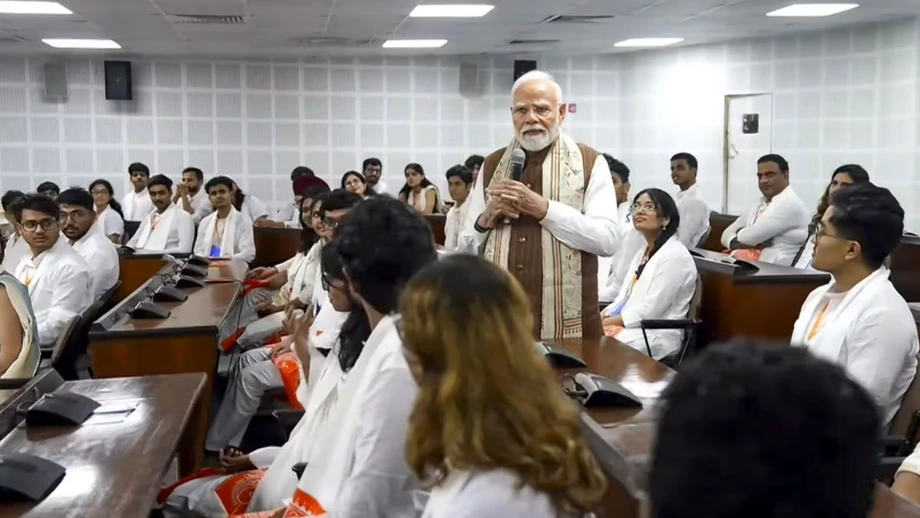
Prime Minister Narendra Modi Visits IIT Kharagpur
Prime Minister Narendra Modi travelled by road to the campus on November 21 to attend the platinum jubilee celebrations of the first Indian Institute of Technology in the country. He landed at the Kalaikunda air force base in the Paschim Medinipur district of West Bengal before arriving at the institute to mark 75 years of academic and technical history. The event brought together students, professors, alumni, and staff at the Netaji Auditorium to discuss the future of the nation and the path toward a developed economy.
สารบัญ
Dignitaries present at the celebrations included West Bengal Chief Minister Suvendu Adhikari, Minister of State for Education Sukanta Bhattacharya, and Higher Education Minister Jagannath Chatterjee. During the visit, the Prime Minister toured an exhibition of student projects and research prototypes at the Senate Hall alongside institute director Professor Suman Chakraborty. The exhibits showcased start-up ideas in agriculture, textiles, robotics, aerospace engineering, drone technology, and affordable healthcare solutions.
Reflecting on History and Limiting Beliefs
The Prime Minister noted the unique historical background of the campus, which stands on soil that once housed a British detention camp for freedom fighters. He urged students to draw inspiration from the bravery of those who desired self-rule, contrasting the past struggle for freedom with the present opportunity for technological self-reliance. He argued that a nation discovers its true capabilities only when it breaks the boundaries of conventional thinking.
Urging students to shed limiting beliefs, the Prime Minister stated that individuals and countries must not restrict their dreams or talents. He recalled how critics had doubted his plans when he first announced nationwide sanitation initiatives from the Red Fort, comparing those early doubts to current aspirations for national development. The institute has evolved significantly since its establishment in 1951, moving through decades of transformation alongside the country's broader industrial and technological growth.
The Semiconductor Mission Debate
Addressing the gathering, the Prime Minister accused past administrations of missing an early opportunity to build a domestic semiconductor industry 50 years ago. He stated that a foreign company attempting to establish a semiconductor facility in the past had been driven away by restrictive political protests. Semiconductors are microscopic electronic circuits carved onto silicon wafers that perform calculations, store information, and control electrical power for modern devices ranging from smartphones to defense equipment. While the Prime Minister did not name the company during his speech, a historical post by Union information and broadcasting minister Ashwini Vaishnaw pointed to Fairchild Semiconductor founder Robert Noyce visiting India in 1964 and facing regulatory hurdles before founding Intel in Hong Kong.
Historian of technology Dinesh C. Sharma confirmed that restrictive industrial policies in the 1960s prevented large-scale semiconductor manufacturing by demanding equity limits and production caps that firms found unacceptable. The Prime Minister defended his current semiconductor mission against initial skepticism, noting that multiple semiconductor facilities have been established in just four years and the country has begun exporting chips. Opposition leaders from the Congress and the Communist Party of India Marxist criticized the historical claims, arguing that the accounts were inaccurate and that the institution itself was founded during early governance under Congress rule.
Engaging Young Innovators and Space Reforms
The discussions at the platinum jubilee included a special interactive session under the '75 Voices for Viksit Bharat' initiative, where the Prime Minister spoke one-on-one with 75 meritorious students. Institute director Professor Suman Chakraborty assigned the students specific challenging problems to solve as part of the programme. The Prime Minister proposed that student cohorts identify 100 imported products and develop domestic alternatives to bolster the country's self-reliance in manufacturing.
Student presentations during the exhibition highlighted advanced work in aerospace and defence, including supersonic unmanned aerial vehicles and electronic warfare resilience. The Prime Minister noted that opening up the space sector beyond the Indian Space Research Organisation had unlocked doors for young innovators, pointing out the success of private space ventures like Skyroot Aerospace co-founded by institute alumnus Pawan Kumar Chandana. He emphasized that young innovators now have unprecedented opportunities to drive technological progress from ships to space rockets.
Tackling Data Challenges and Poverty Reduction
Focusing on data management and artificial intelligence, the Prime Minister described data as the new gold or the new diamond while pointing out a major operational hurdle in government administration. He explained that various government departments and organizations maintain isolated datasets that do not communicate with one another, creating a need for integrated software solutions tailored to local requirements. Students also presented machine learning projects aimed at generating aptitude certificates for schoolchildren based on interests rather than conventional character assessments.
The Prime Minister cited a recent World Bank report stating that approximately 50 crore people in India have emerged from poverty over the past 12 to 13 years. He attributed this massive demographic shift to a systematic shift in policy thinking and empowerment schemes focused on ease of living. Opposition figures countered these claims by pointing to international hunger and democracy rankings, arguing that governance challenges remain pressing across the country.
Education Parity and Future Leadership
In a related address in Lucknow later in the evening, the Prime Minister emphasized the vital role of Industrial Training Institutes, placing their trainees on a par with university graduates. He stated that skilled youths are essential for turning the country into the skill capital of the world, noting that a world skill convention will take place in Greater Noida next year. He urged parents and society to respect practical technical training as much as traditional university degrees, arguing that technical skills will command greater respect in a changing economic landscape.
Concluding his address at IIT Kharagpur, the Prime Minister told students that the next two decades will be decisive as many of them assume leadership roles by the target year of 2047. He asked them to approach every national challenge with a Nation First mindset. He ended his speech by invoking the philosophical words of Swami Vivekananda to inspire the young audience to pursue their goals without stopping.
Timeline of Key Developments
- 1951: IIT Kharagpur is established as the first Indian Institute of Technology to support industrial and infrastructure development.
- 1964: Fairchild Semiconductor explores operations in India before facing restrictive licensing policies and relocating.
- November 21: Prime Minister Narendra Modi arrives at Kalaikunda air force base and travels by road to celebrate the platinum jubilee.
- November 21: The Prime Minister interacts with 75 students under the '75 Voices for Viksit Bharat' initiative and unveils a commemorative silver coin.
At a Glance
- Prime Minister Narendra Modi visited IIT Kharagpur for its 75th anniversary celebrations on Saturday.
- The Prime Minister claimed a foreign semiconductor firm was turned away 50 years ago due to restrictive policies and protests.
- Historians attribute past semiconductor delays to restrictive industrial licensing policies rather than political protests alone.
- The Prime Minister cited World Bank findings that 50 crore people have left poverty over the last 12 to 13 years.
- Students showcased advanced projects in aerospace, drone technology, and data analytics during the presidential exhibition tour.